Thursday, November 26, 2009

History of Thanksgiving


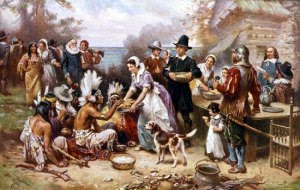
Today many of us in the United States and Canada will be gathering with friends and family to consume copious amounts of turkey and "give thanks" for those things in life we are grateful for. A vast majority of Thanksgiving Day participants probably know very little about the history of this holiday. Allow me to enlighten you!

In 1620 a group of English Separatists, now commonly referred to as "pilgrims," arrived at what is now Plymouth, Massachusetts. The original pilgrims were mostly upper class folks who did not know much about farming or life outside of Mother England.

The winter of 1620 was harsh and it devastated the new colony, wiping out about half of their meager population. Following the death of most of their loved ones, the pilgrims decided that they needed some help. So they established a tenuous relationship with the neighboring Wampanoag tribe.

The Wampanoags spent much of the next year teaching the pilgrims how to survive Massachusetts' harsh winters. They taught the newcomers how to hunt, fish, and farm for food. By the autumn of 1621 the pilgrims had learned a great deal, and the colony had harvested enough food to last them through the winter. As a thank you to the native americans who had helped them with this monumental task, the settlers invited the Wampanoag to a three day feast to celebrate their harvest. Though the original participants certainly did not do so, this feast is now commonly referred to as "The first Thanksgiving."

Shortly after this feast relations with the neighboring Wampanoag began to unravel, and many bloody attacks resulted from the pilgrims' attempt to push their colony outward. By the time the 1700s rolled around the Puritans had settled much of the Northeast and unsurprisingly they held feasts of "Thanksgiving to the Lord" throughout the year. These feasts celebrated everything from a good harvest to a battle won against neighboring "indians." These feasts were religious in nature, in large part due to Puritan society itself in which the sacred and the secular were mixed and melded so that each seemed inextricably connected to the other.

In the fall of 1789, following the rousing defeat of the British at Saratoga, George Washington decreed that Thursday November 26th would be "A day of publick thanksgiving and prayer" to commemorate this particular victory. The nation celebrated the battle that year, but the holiday of Thanksgiving did not become an annual event until much later.

In the mid-nineteenth century America was on the brink of Civil War. A young woman named Sarah Hale became convinced that setting aside a national day to give thanks would help unite the country. She began a campaign of letter writing, contacting politicians all over the United States.

By 1863 Hale's idea had reached Abraham Lincoln. Following the Battle of Gettysberg in the same year, Lincoln instituted that a "Day of Thanksgiving" should be set aside and that this day would occur annually on the last Thursday of November. Lincoln believed that Thanksgiving would serve to unite our country and bring a stop to the Civil War.

It didn't. Yet this holiday is still celebrated annually. In 1924 Macy's threw their first Thanksgiving Day parade, and the tradition has continued ever since. So Happy Thanksgiving everyone!

Wednesday, August 26, 2009

Hello 19th Amendment!

Right: Photo of suffragists at the Seneca Falls Convention in Seneca Falls, NY. Photo courtesy of University of Nebraska Omaha archives.

Eighty-nine years ago today the 19th amendment was formally adopted into the U.S. Constitution, guaranteeing women their right to vote. By 1920 more than 70 years had passed since the beginnings of the women's suffrage movement. Women had famously rallied in Seneca Falls, NY in 1848. In 1850 the first ever national women's rights conference was held, and this conference was repeated annually ever after. Women wanted equal rights in employment, finances, and politics. They wanted their voices to be heard, and in 1869 led by Susan B. Anthony, women founded the National Women's Suffrage Association. By 1890 only one state, Wyoming, had changed its laws in order to allow women to vote.

In 1916 women suffragist had been fighting long and hard to no avail (only 4 states in total allowed women to vote: Wyoming, Colorado, Utah, and Idaho), so they changed their tactics. Women picketed the White House and staged acts of civil disobedience across the U.S.

Finally on August 26, 1920 Congress heard these women's cries and instituted a law that would allow them to vote. Many of the early suffragist leaders had by this time passed away, but their work was carried on without them and their dreams were finally a reality. In the 2009 presidential election more women voted than men. A woman even ran in the presidential primary.

As women we have a long line of suffragist, some like Susan B. Anthony and Elizabeth Cady Stanton whose names we know, some whose names we will never know, to thank for our right to be heard in a political election. Unfortunately, there are still places in this world where women either lack the right to vote or possess only partial suffrage. Women in the United States certainly owe a debt of gratitude to the suffragettes who came before us, and it is the purpose of this blog to remember those women with thanks.

Available online source for more information can be found here.

Monday, August 10, 2009

2,700 Year Old Tablets Found

(Photo by J. Jackson)

A University of Toronto led excavation in Tall Tayinate, the capital city of a Neo-Hittite kingdom in ancient Palastine, located in modern Turkey, has turned up a cache of 2,700 year old cuneiform tablets. The tablets were located in a recently discovered temple, inside the temple's cella, or a room called the holy of holies. The writings appear to be part of some kind of archive and are remarkably intact. The tablets date to the Iron Age and may provide insight into Assryian religious and political life. The team also unearthed libation vessels, ornamented ritual objects, and implements made of gold, bronze, and iron.

Timothy Harrison, professor of Near Eastern Archeology and director of the University of Toronto's Tall Tayinate Archaeological Project, was quoted by Science Daily as saying, "The tablets, and the information they contain, may possibly highlight the imperial ambitions of one of the great powers of the ancient world, and its lasting influence on the political culture of the middle east."

Tayinate was once destroyed by the Assyrian king Tiglath-pileser III, and was thereafter converted into an Assyrian provincial capital. Dr. Harrison says that Tayinate was, "equipped with its own governor and imperial administration." It was a very important city in the ancient Near East. This discovery may even hint at Biblical proportions.

Dr. Harrison informed reporters, "Scholars have long speculated that the reference to Calneh in Isaiah's oracle against Assyria alludes to Tiglath-pileser's devastation of Kunulua--i.e. Tayinate. The destruction of the Luwian monuments and conversion of the sacred precinct into an Assyrian religious complex may represent the physical manifestation of this historical event."

In any case, the artifacts were well preserved and tablets should reveal interesting data soon.

Tuesday, April 14, 2009

Titanic Goes Down: April 14, 1912

Sometime prior to midnight on April 14, 1912 the RMS Titanic struck an iceberg. Five of the ship's sixteen compartments were ruptured and the ocean liner began to fill with water. A few short hours later (sometime around 2:30 a.m) the Titanic sank to the bottom of the icy Atlantic.

Due to a shortage of life boats most of the passengers and crew drowned. 1,500 people lost their lives as the world's first "unsinkable ship" sank.

Many passengers displayed unfaltering bravery as they forsook their own lives in order to save others. The captain, as captain's should, "went down with his ship". The band bravely played until they too drowned. Mr. and Mrs. Earnest Courtenay Carter famously refused to board lifeboats saying, "let the others go first," and the childless couple bravely died together. Miss Edith Corse Evans let another woman, Mrs. John Murray Brown, take the last remaining spot aboard lifeboat D, saying, "You go first, you have children waiting at home." Miss Evans never found space aboard another lifeboat and drowned when the Titanic sank. Many of the 700 survivors were "given" their seats aboard lifeboats by brave individuals who opted to stay aboard and help others to safety.

Then of course there is the famous "Unsinkable Molly Brown" who forced her lifeboat to turn around and help pull other survivors from the icy Atlantic. Miss Brown is credited with saving several lives and with keeping spirits up when all else failed.

These remarkable stories of heroism and bravery resonate with us today and keep the memory of the Titanic alive.

Friday, March 13, 2009

Dancin' Voodoo Queen

This painting is the image most often associated with
famed Voodoo (Voudou) Queen Marie Leveau. The original painting can
be seen in the Cabildo in New Orleans, LA.

Marie Leveau was born sometime between 1790 and 1801 in the French Quarter of New Orleans, Lousiana. The exact date of her birth is unknown as the documentation of such things was rather casual during this period, often taking several days for someone to jot down a birth or death date (thus resulting in conflicting records of both). It is believed that Marie was born to a wealthy white planter and free creole woman. The rest of her life is shrouded in mystery, and what we do know is sporadic and fascinating.

From all accounts it appears that our dear Marie Leveau, soon to be Voodoo Queen, was raised a devout Roman Catholic. She never really let go of her Catholic roots, as Voodoo is a syncretic religion blending traditional African religions with Roman Catholicism to create something that reflects varying aspects of two seemingly unconnected spiritual paths. So our cajun Voodoo Queen was also devoutly Catholic.

It also seems that Marie married twice and had a total of 15 children between her two husbands. Her daughter, also named Marie Leveau, is often confused with her mother, making the history of this fascinating woman even harder to nail down. Her first husband, Jacques Paris, died sometime around 1820 under unexplained circumstances. Some accounts actually say he disappeared and was never found. In any case Leveau became involved with another man, Christophe Glapion, and bore him children as well.

Leveau became a hairdresser for affluent white families after her first husband's disappearance/death. She made powerful connections and many historians believe that she exploited these connections to create her own power in New Orlean's society. Some claim she had a vast network of spies within her wealthy clients' homes and these spies fed her information about her clients.

White and Black, rich and poor, came to Marie Leveau with their problems. They bought her potions and charms, and according to most accounts those potions and charms worked. People held Leveau in awe and many feared her. She is best known for her St. John's Day rituals on the banks of the Bayou St. John. Thousands flocked to see Marie Leveau, Voodoo Queen, dance with her powerful snake Zombi and perform Voodoo "magic" in celebration of the holiday.

It is recorded that Leveau cared for injured soldiers following the Battle of New Orleans, and again during the Yellow Fever epidemic of the 1850's. She owned a house in New Orleans. Some claim she also owned a brothel. She prayed with rosary beads, danced with a snake named for the African God Zombi, revived Voodoo in America, gained a following of thousands, was loved and feared, and had powerful white allies. She died in 1881. Followers of Voodoo still visit her tomb in St. Louis Cemetery, leaving her gifts and tokens of appreciation. She is revered in death as she was revered in life. Her "magic" still echoes today.

Sunday, March 8, 2009

Rosie the Riveter

March is women's history month. In honor of all the women that came before me, I am going to try to write at least one article a week regarding women's history. This week I chose Rosie the Riveter!


This particular image by J. Howard Miller is actually entitled "We Can Do It!", and happens to be the image most associated with "Rosie the Riveter". This painting, however, was actually based on a woman named Geraldine Doyle.

Rosie the Riveter came to represent women in the United States during World War II. "Rosie" left behind the traditional women's role as only wife and only mother to work in factories building everything from B-29 bombers to warships. This iconic character convinced women that it was their patriotic duty to enter the workforce and participate in the "war effort at home".

Many women's studies scholars believe that Rosie the Riveter forever changed gender norms in the U.S., finally opening the door for women to join the workforce. Other disagree. Whatever you think, you have to admire the real life "Rosies" who were forced to forgo nylon stockings for the war effort and instead painted their legs with pancake batter and drew a seam down their calves with eyeliner, who slapped overalls over their skirts and dresses, and wielded heavy machinery in a grueling factory for hours on end all to play their part in the world's greatest war. Below is an image of a real life "Rosie". Enjoy!


Sunday, March 1, 2009

Step By Step: Ancient Footprint Found in Kenya


Several fossilized footprints were discovered in Kenya near Ileret earlier this week. Scientists estimate that these footprints were made nearly 1.5 million years ago by our early humanoid ancestors, Homo erectus. Most of the ancient footprints appear to be adult, however one set of footprints is believed to have been made by a child.

Archaeologists were able to calculate the approximate height of these early bipeds and it seems that the ancient people who left these footprints were around 5'7" tall. They also estimate that they were similar in weight to modern humans.

This find provides solid evidence that Homo sapiens, our species, which first appeared around 200,000 years ago were not the first bipeds. It proves that our ancient ancestors, the Homo erectus, were bipedal 1.5 million years ago. The impressions themselves are also astounding in their preservation. Many of these footprints appear to have been made just yesterday. These footprints are literally a walk in the past.